Threadbenders Quilt Shop

Threadbenders Quilt Shop
Showing posts with label machine applique. Show all posts

Wednesday, May 7, 2014

Machine Applique: Fast As We Can

We know about quilting as zen. People always ask me about my patience. They have no idea. I've no patience at all. I want that baby done.
Machine applique is often the answer for that. There are myriad techniques that go from hand sew look alikes to raw edge wonders. We'll explore those today.


The secret about machine applique is that you want it to stay put while you stitch it down. Reasonably enough. The simple answer to that is our last blog post. If you want to stitch by machine, you fuse it as a basting.

Couldn't you just trust the glue and not stitch it? Sure. I can also trust two dogs not to touch a baked chicken that's landed on the floor. We can do almost anything. But some things just don't work the way you would like. Glue is not always permanent, not always applied well enough and not always trustworthy by itself. You could get lucky or not. If you want it to stay stuck, stitch it down.

From Julie Baird at Generations
 The applique can either be turned under or not. This is a surprisingly strong method


Karen Woodruff
Straight stitch applique. 
You can just run a stitch along the edge. It gives a modern and wild kind of look that can be a lot of fun. It needs some kind of other reason to stay on. I'd fuse it first.
From Ellen Luckett Baker at The Long Thread

Zigzag applique:
Fed zigzag applique ( with the feed dogs up) gives a solid blocky line. It's a nice finish that's very durable.

From Thread Magic Garden Ellen Anne Eddy


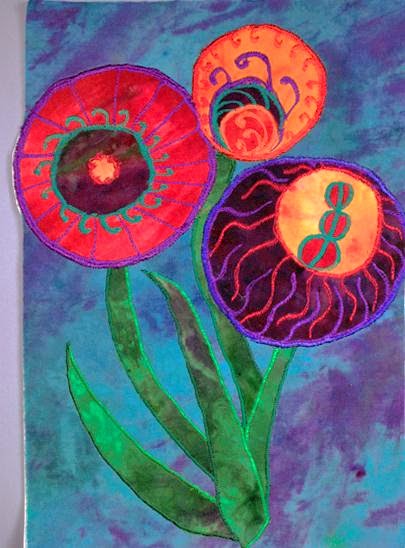
Free motion applique: This is applique done with a darning foot zigzag. It gives a more fluid line that can be shaded with more stitching.

What ever you choose, you'll be done in a flash. And sometimes that's just what you need.

Friday, May 2, 2014

Fusible Applique: Lickity Stick

Pictures from Thread Magic Garden, by Ellen Anne Eddy
Hand applique is pretty. Calming. Historic. A bit time consuming.
So is there a way to speed this up? Of course there is!


Fusible applique is the lickity split way to applique. Instead of turning your edges you either cover them  with some kind of stitching, or you don't. But either way, you fuse the applique pieces to your top fabric first.

Kinds of fusibles
Fusibles come in several classes

  • Unbacked: 
These are raw spun webs or films of nothing but glue. They have no paper backing. Some of them are formulated to be less stiff. You need to be really accurate to use these. You want to applique piece to completely match the glue so it's really stuck and so it doesn't bleed glue around the edge. You probably want to use a teflon ironing sheet to protect your iron and ironing board.


Backed: Paper backed fusibles have a paper backing. It protects your ironing board and  iron. It can be ironed onto the fabric and then you cut the applique pieces. Which means it really is accurate and you don't have glue bleed. These fusibles have one paper side and one glue side.
  • Tacky: These fusibles can be finger pressed onto your fabric, cut and then ironed down. Like a peanut butter sandwich you have two pieces of paper, and glue in the middle. You peel one side, pat it on to your fabric and cut your shape. Then  iron it down.
Web textures
Most webs have a texture of some kind. It will show through. Films and webs work better than webs with a formal glue structure on the back. Of course if you stitch enough on it, who will know?

Some of the first fusibles have been around for over forty years now, and have proved permanent. But  I don't ever trust it as a finished product. You might if it's:
  •  a piece you never intend to wash.
     If it's just going up on your wall, it's probably fine, but cleaning it is going to be dicey if you ever need to.

  • a piece that will never be rough handled. Keep in mind that shipping or traveling quilts to show can be very rough handling. 

Most people stitch after they fuse in some regards. But fusing fabric changes its texture. It's much harder to stitch through. So stitching by machine is probably the way to go.
Next time we'll talk about machine stitching applique.

Friday, April 25, 2014

Exploring Piecing and Applique: Yes, You Can Do It All

Applique quilt from Quilt Sister
You've probably heard people declare, I'm a "piecer", or" I do applique". They really are very different techniques.And they offer such different possibilities. We're going to look at applique over the next week, but before we do that, let's unpack the differences.


From Fussy Cutter Quilter Kits
Piecing is the sewing of fabric together in seams. We've talked a great deal about piecing. It's usually where beginning quilters start.

Piecing is almost always in straight lines. Except when it's not. There are fabulous curved piecers and piecing, but it's a high skill trick. Much piecing that looks curved is actually an optical illusion. It's worthy, it's lovely and it's very exacting.


Sue Makinen's Applique 
Applique is applying fabric on top of another fabric. Applique is the land of the curve. There is straight line applique, but one is tempted to ask," why?" It's so much easier to piece straight lines and so beautiful to applique curves.


by Barbara Baatz Hillman
There's also nothing against both piecing and applique within the same quilt. It's an astonishing combination that gives you the best of everything.


From Thimble Lady


But that being said, there are a lot of techniques within that. The biggest decision is whether to work by hand or by machine. 
There are wonderful reasons for both.


Hand applique is

  • Elegant and delicate
  • Can be intricate
  • Traditional
  • Portable( you can easily carry it with you)
From Sew Momma Sew
Machine Applique is
  • Faster
  • Less Intricate
  • More contemporary (usually)
  • Needs to be done in your sewing room with your machine.


In a way, the differences are almost along personality lines. Do you need to finish up fast, or do you want to do a long term masterpiece?
Both are fabulous. Applique is a wide world and we'll explore a good chunk of it. 
Sue Makinen is teaching a class on  hand applique for us on Saturday May 3rd, at 10:30-3.You can find more about Sue on our Blog Post Applique Treasures: Sue Makinen.

Wednesday, February 26, 2014

Fussy Cut Applique: Modern Broidery Perse


We' ve been talking about piecing with those great novelty prints. And it's a whole lot of fun.
But there is another way: applique!


Broidery perse one of the earliest American quilt techniques. The very first prints in England and America came from India. They were extraordinarily expensive and frugal quilters used them very sparingly. So they would cut out some of the fabulous flowers and paisleys and applique them onto a white/cream background. Tree of life was one of the most popular patterns. The flowers/foliage on the tree would  be cut and appliqued from the chinz.
P&B Textiles
Of course, everything old is new again. Quilters have rediscovered fussy cutting as a way to applique those amazing english rose prints and more.


Original broidery perse was needle turned, hand stitched and very labor intensive. There are people who still have that skill, but modern fusible webs give us another alternative.
The Crafty Quilter
You can back your applique flowers with fusible, fussy cut them to your delight and apply them with a hot iron. A talented sewing machine with a button hole stitch makes a darling edge. Or an inobtrusive zigzag will work in a pinch.


You can place a fabulous image from your print right where you want it. How cute is that!