Threadbenders Quilt Shop

Threadbenders Quilt Shop
Showing posts with label quilt. Show all posts

Wednesday, June 4, 2014

Why Dye?: Some Thoughts about Dyeing Wool

Sue Makinen's Wool Applique
Since Sue Makinen has joined us at Threadbenders, we've gone a bit applique mad. It's around the bend a bit, but didn't we all want to travel?


Our Vintage Wools
That being said, we started to talk about wool. And wool is truly wonderful to work with. It needles beautifully, you can do astonishing applique with it, and it feels wonderful to work with. 

We have a great collection of vintage wool pieces that are amazing for applique. And we have Sue as our guide, mentor and inspiration.


Peg's Wool Block
Then Peg started to work on this block with hand dyed wool.It's beautiful. No doubt about it. 

But why dye? Why would you make that kind of mess?

Personally I get asked that all the time and the answer is easy. I'm just that messy.


Three Sheep Studio
But dyeing gets you fabric you just can't get any way except by dyeing. Unless you know someone else who can dye it and will share.

Why would we dye?
Several reasons:

From The Cotton Patch
  • You can get colors you just don't find anywhere else.There probably isn't much vintage orange, lime green, purple plum, and bright pink wool anywhere. I can't work without those. Can you?
    Page by Leslie Main Johnson 
  •  You can get ranges of colors. It's nice to have one brown. It's fabulous to have 3 or 4.
  • You can have it in quantities that are useful for your work
  • A vintage piece of fabric is only as big as it is.I know that sounds obvious, but when you want it for a background and it's in three inch pieces, it is a heartbreak. If you're dyeing your own, it can be in useful sizes.
    From The Wool Garden

  • You can get variations in fabric color that are really gorgeous for floral applique especially. Mottled colors are very beautiful in all kinds of flowers, and echo the real shades from a garden.

  • You can have fabric that shifts colors. Imagine vines made out of fabric with several greens in them. Are you there?

Finally we have a collection of people in our store doing applique who might really want it.

So we're thinking about it. I dyed up some tiny samples just to get a sense of the process, and we're considering dyeing wool for the store. Are you interested?
Let us know what you think!

And look for Sue's wool applique class coming soon. 


Friday, May 30, 2014

What Kind of Fabric is That? Why Cotton and Wool are Queen and King of the Quilting World

Peg's new wool applique block
There's a mystery solved on the end of every fabric bolt. You can probably find the manufacturer, the width of the fabric and what the collection is called. Somewhere in there it should tell you what it's made of.

If you're in a quilt shop it probably says 100 % cotton. There are some very good reasons for that. Cotton has always been the go-to fiber for quilters for a lot of reasons.

Cotton

  • It's soft.
  • It's washable.
  • It dyes well and has great colors.
  • It's hyper allergenic.  
  • It pieces well.
  • It irons flat.
  • It can be blocked a little.
But cotton's not the only fabric to quilt with.Wool is an old quilting choice that's all new again. Pretty wool solids make for fluid applique and a hardy textural kind of pieced quilt. Because it's a thicker fabric and more loosely woven, it feels very different to work with, but in a good way. Here's some of the reasons wool is a great alternative quilt fiber.

From Winterberry Cabin
Wool

  • It has a fabulous texture
  • It dyes well, but with different kinds of dye.
  • It needles well for hand applique.
  • It has a more raised feel and hand.
  • It's extra warm and snugly.
  • It can be blocked into shape.
Wool often has other fibers blended in with it. Unless it's a significant amount, say 15% or more, it usually doesn't make a huge difference. But of course, pure wool is best.

Fabrics you want to avoid.
When you walk outside the quilt shop there are all kinds of other fibers that are not so user friendly. This isn't like they aren't pretty or that they have their own uses. They just don't respond well to quilting techniques or they don't wear well. Here's why.

Rayon
Rayon is made of tree bark. It's soft. It's pretty. But it's much too fragile to quilt with. And it sun fades very easily.

Test Tube Babies
Polyester and other test tube babies are not great quilting fabrics. They don't piece well and they are miserable to iron. And if they're mixed into a fiber blend, they still have the same issues. Do you remember the polyester double knit quilts of the 70's? Need I say more?

Lycra is a fiber that stretches. Great for sports wear. Miserable for quilting, as it has to be either stabilized or it will bounce along as you try to quilt on it.

So what happens if you find the perfect color or print and it's rayon. Or lycra? Or poly? You can use it. You can do anything that isn't illegal or deadly. But you deal with the limits and problems of those fibers for the whole life of that quilt. Did it fade? Rip? Sag? Pull out it's stitches? Cotton and wool are queen and king of the quilting world for very good reasons. They work, piece, applique, quilt and needle so much better. 

How long does it take you to make a quilt? How long will that quilt be part of someone's world? No one can afford poor fabric choices. They're just too costly in the long run.


Sue Makinen's great pin cushion
We have a new collection of vintage wools that are perfect for applique. Sue and Peggy have gone insane about them. Sue will be teaching us about wool applique and embroidery on wool in a series of upcoming classes.

Our vintage wool collection
All of this is a reason to be shopping for fabrics at a quilt store. We know what's in the fabric. And it's the best quality for quilting, all the time. Surprises are really only nice on birthdays and Christmas.

Wednesday, April 30, 2014

Hand Applique: The Embroidered Edge

From Rocky Mountain Quilts


There's another traditional form of hand applique.

Rather than make the stitches invisible, you can pump them up and make them shine.
From Mrs. B's General Store
This became particularly popular in the thirties. There were a lot more applique quilts as cotton fabric more available and didn't need to be in tiny pieces. 
Found on ebay.com
Many quilters decorated their edges with embroidery.
Very basic embroidery stitches work really well as a way of edging an applique. Most people stitch the fabric down as classic applique and then embroider them with basic edging stitches. The running stitch, the stem stitch and the buttonhole stitch are some of the best.

Embroidery cottons from Threadarific
All kinds of cotton embroidery threads work for this. Pearl cotton, embroidery floss and crochet cotton come in different sizes and every color.


Patsy Thompson Designs

This also looks really great on wool applique.
From Aurum Eve


From Fiber Luscious

Of course there's no reason it has to look old fashioned because it's old. It's a way to dress up and excite all kinds of contemporary design.

Friday, April 18, 2014

Seminole Stripping: Not Done in the Nude

Kathleen McCormick From Cambridge Quilts
We've talked about cutting strips and resewing them to make intricate patchwork.


The Seminole Indians have always been the masters of this. Seminoles were a tribe in the Florida cypress swamps. The people who had come to Christianize them also taught them to sew quilts as well. But they were developed a form of  strip patchwork that involved stitching, cutting and restitching.
 Vintage Seminole Skirt From/Miss Farfalla's Etsy Shop
Traditionally they made clothing with their piecing. This is a traditional Seminole skirt. They also made jackets, shirts and other garments, as well as quilts.


Seminole Pieced Apron from Ms Sews It All
It's easier to understand how this piecing is accomplished by seeing the back. It's all strips, cut at different angles and resewed.


Here are several construction diagrams. 


From Lakeview Stitching


From Creating So Many Colors
Seminole Tutorial
Karen Pior has this fabulous tutorial on her page at Sew Well Maide.


Contemporary quilt by Niki Valentine Vick
Seminole piecing is quick, very intricate and beautiful. 


Traditionally it's done with solids, but traditions, like rules, are made to be broken.
If you'd like to add amazing pieced detail to your quilting, Seminole pieces is an easy way.

Wednesday, April 16, 2014

Bargello U: Easy Bargello Piecing

We've talked a bit about how to make things in strips that look so much harder than they are.


Bargello piecing is so impressive looking. All those little pieces, done square after square. And it took you, how long? 
Don't be silly. We don't do hard here and we don't do time consuming. Bargello piecing is lightning fast.
These great fabrics are all part of the same fabric line and they're in stock in the store. You can sew along, if you want.


Take a number of strips. Sew them together. 
Cut them into segments.
The segments can either be the same or graduated in different widths. There's really no wrong way to do this.


Sew the segments at each end to each other to make a ring.This is the part my photo shop skills can't quite master. Would you please imagine I can show you that?
Sew the segments together moving up one square at a time.  
If you do different sized segments it looks like this.
Cut across all the segments to make it one bargello piece.
Tada! That wasn't that hard. It looks like a mountain of bits sewed together, but since we started with strip it's fast as a flash.
Things to remember when sewing strips:

  • Even counts. Keep your seam size as accurate as you can. It doesn't matter what it is, just be consistent.
  • Use a sharp rotary blade. Always. Actually it's much safer.
  • Trim you strips to straighten them up. They will get funky after several cuts
  • Press with steam when you're done, from the front. You'll want to make sure all the seams are flat and open.
  • Do lift and press rather than running an iron over it.
  • Seams in the back can point any way they like. It's better if you press to the dark side, but if they're inside your quilt making comments, squish them out. 
Sew up some seams and start cutting and stitching. It's endless fun and you'll find yourself amazed.


Friday, April 11, 2014

Challenging Times: How Challenge Quilts Help Us Grow

If you belong to a quilt guild you may have made a challenge quilt. They're fun. You're given several fabrics to work with and you see what you and your friends make of that.


But not all challenges are that formal. When you're in a group with quilters it sort of happens naturally.

We got this red and cream collection of fabric. Paula looked at it and decided she needed to make a hunter's star. It was so cute.


Peg loved it. But she wanted to try it as a lazy l quilt. Such a fun dancing pattern. She made a great lime binding for it.
Wanda made a great disappearing nine patch. And decided she had to put a lime border behind it. 

Would Wanda have made this great quilt if Paula hadn't made her's?  Maybe. Wanda's pretty amazing. But Paula made hers. Peg made hers. And that got Wanda going.

If we are around other quilters, we learn from them, we try what they try, we find new ways.  

So go find some quilters, and just as you watch them, you'll find yourself challenged to new things. Of course the day to day easy way to do this is to walk into the quilt store and see what's new. And we're here every day but Sunday.

Come in and see what you're challenged to do next.


Wednesday, April 9, 2014

Solid Backgrounds: Anything but Plain

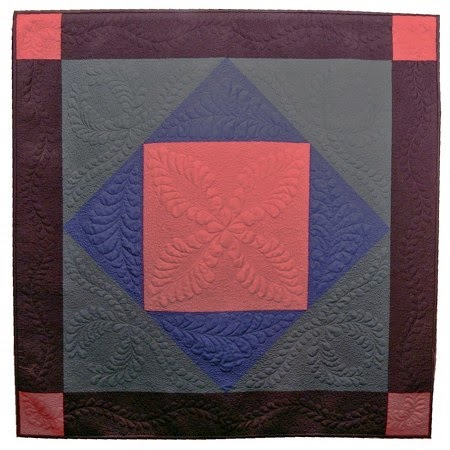
Diamond in a Square, Lancaster County, PA, c. 1925. Gift of Irene L. Walsh.
We've spent over a week looking at backgrounds.

 It's worth saying that a quilt is all in a whole. 


An amazing piece of piecing with wild prints has it's own drama. No matter how you quilt it, the piecing and the fabric take the show.


If you treasure the quilting part of quilting, a solid fabric makes a much better surface.
Amish square

The Amish people have given us a huge legacy of some of the most beautiful and unique quilts to come out of  America.
Amish, Lancaster Co., PA | DIAMOND IN THE SQUARE QUILT (detail) | c.1930 | pieced wools | On loan from Keny Galleries -
Amish quilting reflects the simplicity and plain design of the Amish life style. The quilts are solid, plain patterns, sometimes in bright colors. But they quilt. Boy, do they quilt. All of these simple squares or squares on point quilts are encrusted with quilting, of every kind. Some are just simple grid stitching. Others are masterful feathers, curves, clam shells, and stars. 


http://www.hqnawinterfest.com/darci-amish/
Although Amish quilting is part of their unique lifestyle, they're quilts have affected how we all see pattern and design. These plain, solid squares are a canvas for the design of the stitching.
Nestlings Ellen Anne Eddy


Here is a contemporary Amish that was pieced and quilted by machine, Like most things borrowed by popular culture, we've taken the idea and as quilters, run with it. The colors are brighter, the stitching is by machine, but at heart, it's a lovely blank place to quilts.
Nestlings detail

And in the world of long arms, so much more quilting is possible.


If you're getting ready to quilt your masterpiece, you might want to think about solids as a way to showcase your stitching.

If you'd like more information about the Amish, you can start at Wikipedia. Here's a bit from their article about Amish people.
The Amish (/ˈɑːmɪʃ/ ah-mishPennsylvania DutchAmisch, German: Amische) are a group of traditionalist Christian church fellowships, closely related to but distinct from Mennonite churches, with whom they share Swiss Anabaptist origins. The Amish are known for simple livingplain dress, and reluctance to adopt many conveniences of modern technology. The history of the Amish church began with a schism in Switzerland within a group of Swiss and Alsatian Anabaptists in 1693 led by Jakob Ammann.[2] Those who followed Ammann became known as Amish.[3] From Wikipedia

Sunday, April 6, 2014

A Tale of Three Backgrounds: Blending Multicolor Prints


We looked at how the size of a print changes it's value last time.  But those prints were all the same colors, one shade of red and white, changed by the size of the print. Now we're going to look at prints of more than 2 colors.


How much does that change things? In some ways, a lot. In some ways not so much. But you want to be the one in control of your quilt. Knowledge is power.

Here is a range of green, yellow, white and brown prints in differing sizes. Several of them have 
bits of red in them.


A cream color background gives us a very neutral base, where only the pattern within the blocks  show. Incidentally, it would also leave you with four corners you could quilt to a fair-thee-well. It's clean and simple


This cream and medium green background is more textural. The green leaves pull out the olive in the blocks. It's a busier background, but it functions as a slightly olive green cream color.


This third print, with is larger daisies, is harder to classify. It's definitely got yellow splotches that brighten and randomize the background.


What does this tell us about prints as apposed to solids?
A solid color is:

  • Simple
  • Plain
  • Shows up the prints within the block
  • May show dirt or soil
  • Will show extensive quilting

A small print will:

  • Add texture
  • Add or extend the colors in the block
  • Hide quilting

A larger print will:

  • Add a random textural element
  • Add patches of color to the cream background
  • Will show some quilting, but not anything extreme
  • Probably won't hide soil or wear.
All of this can help you make the best fabric decisions for your quilts. Try everything, and see what you like best.