Threadbenders Quilt Shop

Threadbenders Quilt Shop

Sunday, June 1, 2014

Your First Quilt

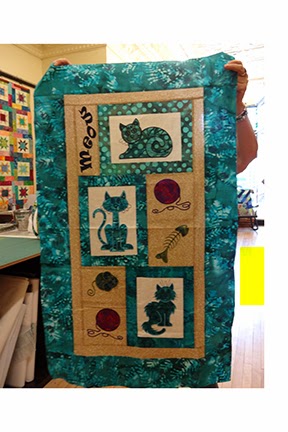
Jane Hunt's cat quilt
Do you remember your first quilt? I don't know anyone who doesn't. A quilter might remember their first log cabin or their first free motion quilting effort. But we all remember our first quilt.

The joy of picking out fabrics and colors. The astonishment as they went together. The ripping of a seam not quite right. The moment when you lay it out to baste the back. It's a magic thing.

It's also a bit embarrassing. There's just so much you don't know.  You either ask for help or you don't. I didn't. God help me for the clueless thing I was, I made a king size log cabin with 5 applique blocks in the center. I also used two bats and a corduroy back, so it could only be tied in the end. It was too warm to use except if the heat cut out. But it was my first quilt. For the hundreds of quilts I've made since then, it was the first step into a world I've loved all my life.

June Baker's leaf quilt

I often hear people who say something like, "This is my first quilt. It's not very good. Please don't take a picture. I'm so embarrassed."

What they're too new in quilting to know is how marvelous that first quilt is. It's a step out into a brand new world of self expression. It's the beginning of a new way to comfort others and ourselves. It's the induction into a world of other women who have helped each other for ever, because it's what we do. Good and bad are irrelevant because if we do anything enough we'll get better at it. But it never happens if you don't start.

Anita Miller's baby quilt
We love it at Threadbenders when a new quilter comes in and asks us to help with their first quilt. It's a privilege to help someone start on a path of creation and joy. It's something we treasure with you. And we won't tell where the boo boos are, unless you do. We have a big work table open at all times and you can come in and work on your quilt with us.  We're right here for you. If it's not your first quilt that's fine too. We all help each other in between the giggling.
So with that said, here are some of the quilts our ladies have been making. They are awesome!
Nancy Mehan's first quilt!

This is Nancy Mehan's  first quilt. She sat with us and made it with the prettiest jelly roll and it is  really pretty. And we are so proud for her.


Friday, May 30, 2014

What Kind of Fabric is That? Why Cotton and Wool are Queen and King of the Quilting World

Peg's new wool applique block
There's a mystery solved on the end of every fabric bolt. You can probably find the manufacturer, the width of the fabric and what the collection is called. Somewhere in there it should tell you what it's made of.

If you're in a quilt shop it probably says 100 % cotton. There are some very good reasons for that. Cotton has always been the go-to fiber for quilters for a lot of reasons.

Cotton

  • It's soft.
  • It's washable.
  • It dyes well and has great colors.
  • It's hyper allergenic.  
  • It pieces well.
  • It irons flat.
  • It can be blocked a little.
But cotton's not the only fabric to quilt with.Wool is an old quilting choice that's all new again. Pretty wool solids make for fluid applique and a hardy textural kind of pieced quilt. Because it's a thicker fabric and more loosely woven, it feels very different to work with, but in a good way. Here's some of the reasons wool is a great alternative quilt fiber.

From Winterberry Cabin
Wool

  • It has a fabulous texture
  • It dyes well, but with different kinds of dye.
  • It needles well for hand applique.
  • It has a more raised feel and hand.
  • It's extra warm and snugly.
  • It can be blocked into shape.
Wool often has other fibers blended in with it. Unless it's a significant amount, say 15% or more, it usually doesn't make a huge difference. But of course, pure wool is best.

Fabrics you want to avoid.
When you walk outside the quilt shop there are all kinds of other fibers that are not so user friendly. This isn't like they aren't pretty or that they have their own uses. They just don't respond well to quilting techniques or they don't wear well. Here's why.

Rayon
Rayon is made of tree bark. It's soft. It's pretty. But it's much too fragile to quilt with. And it sun fades very easily.

Test Tube Babies
Polyester and other test tube babies are not great quilting fabrics. They don't piece well and they are miserable to iron. And if they're mixed into a fiber blend, they still have the same issues. Do you remember the polyester double knit quilts of the 70's? Need I say more?

Lycra is a fiber that stretches. Great for sports wear. Miserable for quilting, as it has to be either stabilized or it will bounce along as you try to quilt on it.

So what happens if you find the perfect color or print and it's rayon. Or lycra? Or poly? You can use it. You can do anything that isn't illegal or deadly. But you deal with the limits and problems of those fibers for the whole life of that quilt. Did it fade? Rip? Sag? Pull out it's stitches? Cotton and wool are queen and king of the quilting world for very good reasons. They work, piece, applique, quilt and needle so much better. 

How long does it take you to make a quilt? How long will that quilt be part of someone's world? No one can afford poor fabric choices. They're just too costly in the long run.


Sue Makinen's great pin cushion
We have a new collection of vintage wools that are perfect for applique. Sue and Peggy have gone insane about them. Sue will be teaching us about wool applique and embroidery on wool in a series of upcoming classes.

Our vintage wool collection
All of this is a reason to be shopping for fabrics at a quilt store. We know what's in the fabric. And it's the best quality for quilting, all the time. Surprises are really only nice on birthdays and Christmas.

Wednesday, May 28, 2014

Almost Solid: The Prints that Don't Look Like Prints


So much fabric is about the prints. And there are mountains of them. Some sophisticated, some Juvenal, something for everyone you might ever want to quilt for. We all have our collections of prints that simple pleased us for the graphics or the subject matter.

But as people get more serious about their quilting, they often want something more versatile and with less cute factor. Today we're going to look at the almost solids.

One of the trends in the art world is to use your own fabric. Did you dye it? Marbelize it? Rust it? Run it through the printer? Have your own design printed? The list seems endless. It's a lot of fun but it's also fairly exhausting. If you don't do those things on a regular basis, you probably don't have the setup, patience and time to produce your own fabric in quantity. It's really out of reach for most quilters.

But with that said, they are pretty. Very pretty. And it's a great look. 

They also tend to cost the earth. They're hand crafted and they take a lot of time and costly materials.


Enter the almost solid prints.
These are the prints that mimic hand crafted fabric. They can be very sophisticated and very versatile. But since they're commercially made, they cost pretty much what ordinary quilt fabrics cost. And they do give you the designer look. Often they are designed by quilt artists as part of their fabric lines.


Solid fabrics are a great choice when
  • You want to make a bold statement
  • You want the block pattern to show strongly
  • You want lots of room to show off your quilting


Almost solids are a great choice when

  • You want a designer look to your fabric.
  • You want some odd/interesting colors.
  • You want a textured feel to your fabric.
Try  some almost solids in your next quilt and see how sophisticated and mod they make your quilting. And you don't have to take them down to the river and beat them on a rock to create that look.


Monday, May 26, 2014

Hexies Gone Modern: Not Just Gramma's Garden

We've had one Hexie Hen Party at Threadbenders and it felt a little bit like a bag of potato chips. Nobody did just one.  They were having way too much fun for that.


But for those of you who are on the fence about joining us, but don't want to do gramma's flower garden, there are some amazing modern hexies out there.


Here's some ways to make an old pattern new.

From All People Quilt
Make it large. It's a big impact, you get done faster, and there's lots of yummy room for quilting, if you wish. 

Found on Pinterest
Make it bold. Bright or unexpected colors always are exciting.
From Singing Stitches
Break the mold. No you don't have to make that grid all the way across the quilt. Leave white spaces for quilting and for emphasis.
From Quiltville
Do something unexpected. Who knew you could make letters out of hexies. But once you've seen it, you can do it.

Use your prints to advantage. Great prints are even better if you fussy cut and showcase them where they're best. Cut them so that the very best bits are in the center showing off.

Don't you dare tell us these quilts are old fashioned. Although my grandmother would have jumped right in and made one too.

Join us every Wednesday at 11:00 for the Hexie Hen party. You don't need to bring anything. Just come, sit, sew, and glow.

Friday, May 23, 2014

Domesticated Bliss: Ginny Williams: From Vintage Collector to Wearable Artist

So often the things we passionately collect become the things that craft our art. Ginny Williams, of Domesticated Bliss says she's been collecting vintage linens, laces and embroideries since she was a child. She has a fabulous collection of flour sacks, table cloths, doilies, tea towels and all the other amazing embroideries largely from the 30s'.


With all that inspiration around her, she's begun to use those fabulous fabrics in a series of apron's and children's dresses.


She started with aprons. And her aprons are lovely! Lots of lace and embroidery. Sometimes she has 4-5 different heirloom pieces within one of her garments.


Recently she took Wanda's Pillow Case Dress class, and took it to a brand new level.
We're so proud for Ginny. She's really finding her stride as a wearable artist.


 Her excellent eye blends just the right textiles together to make a gorgeous "vintage look" garment that is unique. She uses supporting contemporary fabric to make her garments wearable and easy care.

This embroidered overlay was originally a lawn tablecloth. Now it's a pretty pink party dress.


 Blackbird CrossingGinny is going to be at Blackbird Crossing  May 23-24, today and tomorrow, at Three Oaks, MI. Make sure you drop in and see her awesome work.


 (312) 342-4258

Wednesday, May 21, 2014

Matchy Matchy: When to Match Colors, When to Blend Colors, When to Contrast Colors


Quilt by Karen Woodruff
Sometimes you hear the phrase "Matchy, Matchy, when we're describing color choices. It brings us to the question, "How important is it to match colors exactly? What does that do for our design?"

Like most design decisions, it comes down to what you want your design choice to do. There is nothing good or bad but thinking makes it so. Or makes it sew.
It comes down to materials and visual choices. There are two items we're talking about at the moment: fabric and thread.
Materials:
We've talked about fabric that's made to match. There are three ways to think about matching colors. We can  match as closely as we can, pick several choices that blend with each other but are not identical, 
Contrast strongly with a different color, print size, or style. These choices are neither right or wrong. But they do make a statement. 
 Match as closely as we can. 
This is best only when we really can match. If it's close, it often doesn't win a cigar. It can look very awkward. If you can match your colors pretty exactly, it gives a smoother quieter feel to you design.
Pick several choices that blend with each other but are not identical.
Sue Makinen's quilt doesn't match colors but it blends them beautifully.
This is the answer to something that only comes close. If you have a range of 3-4 colors that blend it looks like an intentional choice. And it gives a quilt a lovely scrappy feel.
Contrast strongly with a different color, print size, or style

Bright colors don't need to match. They contrast.

If we really can't match it, don't. Pick a fabric that contrasts strongly with the others. Complementary colors work very well for this. Or pick something that is much lighter, darker, stronger, bigger, smaller, or in some way different. It will shine out like a diamond.
Threads:
Piecing:
  • Choosing thread for piecing is about neutrality. What color can you find that sort of blends with everything you're using. Gray, white, black and beige are really good things to start with. If you're ironing your blocks with the seams turned to the dark side, you, me and God are the only ones who will know. And God and I will be silent.
  • Quilting:
    From Wendy Shepherd at Ivory Spring

    If you feel confident about your quilting skills, nothing is as showy as a contrasting color quilt thread. It's pretty.
    From Wendy Shepherd at Ivory Spring
    Of course if you're a little less sure of yourself, a thread that matches will be more forgiving of uneven work or small boo boos.
When we're matching thread,we want to go one shade darker than you're color. Thread looks darker than it is on the spool just because there's more of it in a chunk. Once it's a single thread, it will look slightly lighter.

Quilting by machine always shows the thread color more because the whole stitch shows on both sides. A hand stitch shows in stitches in and out with the running stitch. It is visually less obvious and makes more of a dimple across the surface than a line.


As we said, there's no right or wrong way. But it helps if your choices are intentional. Because it gives you much more control over how your quilt looks.

Monday, May 19, 2014

Fabric Collections: Not Just What You Put Together in a Drawer

Red Collection
We've talked a little about fabric collections. When you walk into a quilt shop, there are lots of different ways you might find the fabric arranged. Sometimes it's by color. Blues here. Reds there. Sometimes it's by subject. You might find all the flowers in one place and all the white on white prints in another.

But you often find fabrics that are clearly kissing cousins.They're not always the same color but they share the same colors. They go together because they were designed to go together. And the very neatest thing about that is that the designers have thought about what you need for a good quilt.

We've talked about contrast in color. Contrast is what makes a striking quilt. But there's lots of kinds of contrast. There's dark and light contrast. Color contrast. Size Contrast. Contrast helps us to make vibrant quilts with strong and showy design.

But contrast isn't the only concern. One of the other things that a good collection has is a consistent style. Are all the prints soft focus? Deeply detailed? From a particular place or time? Fabrics with the same consistent style hold together even if they contrast strongly in other ways.

Designer panel
Let's look at several collections and see how good designers plan that for us.
We'll need

  • A focus print
  • Small background prints
  • A connected neutral
  • Midsize prints that give size contrast
  • An exciting range of color
    Supporting prints
So how does this work? Do you remember those exercises where you pick one of each category? This is exactly how this works. Pick a panel. Pick a background print. Pick two different size supporting prints. Leave out anything you don't really like. Add happy sewing time. Shake three times and you have a quilt.

Well, something like that. Fabric collections make fabric selection goof proof.